10 Signs Your Website Is Costing You Customers
Is your website losing you customers? Discover 10 common website problems, from slow loading and poor SEO to outdated design, and how to fix them.
Your website should be helping your business attract new customers, build trust and generate enquiries. But what if it's actually doing the opposite?
If you run a small business, having a website is a great starting point. However, simply having a website isn't enough. It needs to look professional, work properly and make it easy for potential customers to find the information they need.
Think about the last time you visited a website that was slow, difficult to use or looked like it hadn't been updated for years. Did you stay, or did you move on to another business?
Your potential customers are doing exactly the same thing.
At Peak Cheshire Digital, we help sole traders and small businesses across Cheshire and the High Peak create and improve professional websites. In this article, we'll look at 10 common website problems that could be costing you valuable customers and what you can do about them.
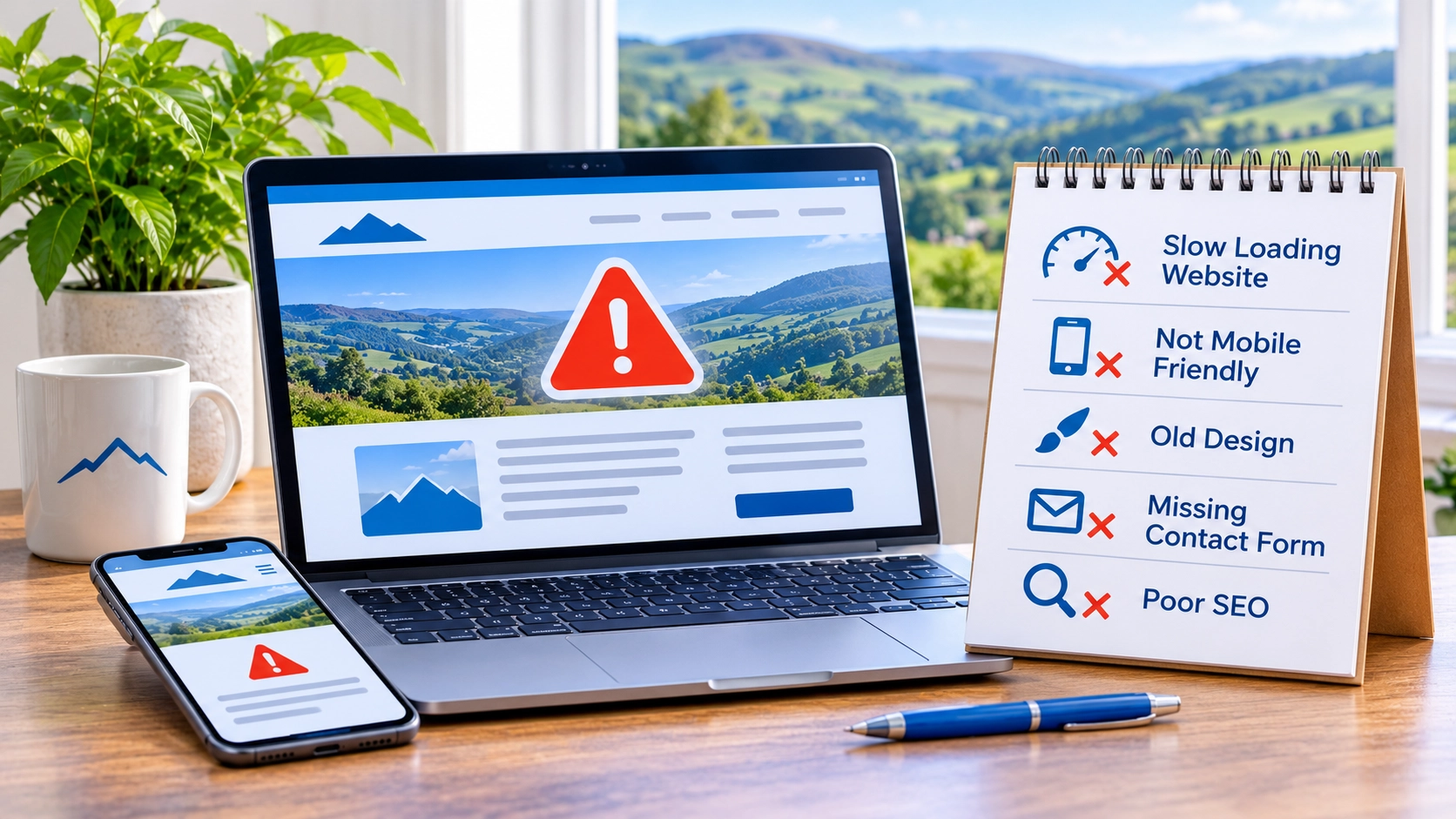
1. Your Website Takes Too Long To Load
First impressions matter, and a slow website can make a very poor one.
People expect websites to load quickly. If a visitor has to wait several seconds for your homepage to appear, there's a good chance they'll simply give up and visit a competitor instead.
Slow loading websites can also affect your visibility in Google search results, making it harder for potential customers to find you.
Common reasons for a slow website include:
- Large, unoptimised images.
- Poor-quality web hosting.
- Too many unnecessary plugins or scripts.
- Outdated website technology.
- Poorly written or inefficient code.
A fast website provides a much better experience for visitors and gives potential customers one less reason to leave.It's worth checking your website using Google's PageSpeed Insights tool to identify areas that could be slowing it down.
2. Your Website Isn't Mobile Friendly
How often do you browse the internet on your phone?
Your customers are doing the same thing. Whether they're looking for a local plumber, electrician, gardener or photographer, there's a good chance they'll be visiting your website from a mobile device.
If your website doesn't display properly on a smaller screen, you could be losing enquiries.
Look out for problems such as:
- Text that is too small to read.
- Images that don't fit the screen.
- Menus that are difficult to navigate.
- Buttons that are too small to tap.
- Contact details that are difficult to find.
A responsive website automatically adjusts its layout to suit different screen sizes, including mobiles, tablets and desktop computers.
Your website should be just as easy to use on an iPhone as it is on a laptop.
3. Your Website Design Looks Outdated
Your website is often one of the first things a potential customer sees when researching your business.
If it looks old-fashioned, cluttered or poorly designed, visitors may question whether your business is still active or whether you take pride in the services you provide.
An outdated website might have:
- Old-fashioned fonts and colour schemes.
- Poor-quality or stretched images.
- Cluttered layouts.
- Difficult navigation.
- Design elements that no longer work properly.
You don't necessarily need an expensive redesign or lots of fancy animations.
A clean, modern design with clear information, good-quality images and consistent branding can make a huge difference.
Your website should reflect the quality of the work you provide.
4. Customers Can't Easily Contact You
Imagine someone visiting your website, liking what they see and wanting to request a quote.
But they can't find your telephone number, there's no obvious email address and they don't know how to get in touch.
There's a good chance they'll move on to another business.
Your contact details should be easy to find, ideally with a dedicated contact page and a prominent link or button on your homepage.
Consider including:
- A telephone number that customers can tap on their mobile.
- A professional email address.
- A simple contact or enquiry form.
- Your business location or service areas.
- Links to your social media profiles, where relevant.
The easier you make it for people to contact you, the more opportunities you have to turn website visitors into customers.
5. Your Website Doesn't Have A Proper SEO Strategy
You could have the best-looking website in your industry, but if nobody can find it through Google, you're missing out on potential customers.
Search Engine Optimisation (SEO) helps search engines understand what your website is about and which searches your pages may be relevant to.
For a local business, this is particularly important.
For example, someone looking for an electrician might search for:
- Electrician in Stockport.
- Local electrician in Cheshire.
- Emergency electrician in the High Peak.
If your website doesn't clearly explain your services and the areas you cover, Google may struggle to understand when it should appear in relevant searches.
Some common SEO problems include:
- Missing or poorly written page titles.
- No meaningful meta descriptions.
- Pages with very little useful content.
- Missing heading structures.
- Images without descriptive alternative text.
- No clear mention of the locations you serve.
Good SEO takes time, but getting the basics right gives your website a much better foundation for attracting visitors through Google.
6. Your Website Doesn't Clearly Explain What You Do
When someone arrives on your homepage, they should understand within a few seconds what your business does and how you can help them.
Unfortunately, many small business websites don't make this clear enough.
They might have a large photograph, a company logo and a vague slogan, but very little information about the actual services being offered.
Your homepage should quickly answer three important questions:
- What does your business do?
- Who do you provide services for?
- How can someone get in touch?
For example, a gardener might have a heading that simply says "Welcome to Our Website".
A much better approach would be something like "Professional Gardening Services in Stockport and the High Peak".
Be clear, be specific and make it easy for visitors to understand why they should choose your business.
7. Your Website Has Broken Links Or Missing Pages
Have you ever clicked a link on a website only to find a page that doesn't exist?
It's frustrating for visitors and can make a business look unprofessional.
Broken links can appear for several reasons:
- Pages have been deleted or moved.
- Links haven't been updated after a website redesign.
- External websites have changed their addresses.
You should regularly check that your website navigation, service pages, contact links and other important buttons are working correctly.
A visitor who clicks on your Services page or Contact button should always arrive where they expect to.
It's also worth checking that your website doesn't contain outdated information or links to services you no longer provide.
8. Your Website Doesn't Build Trust
People want to feel confident before spending money with a business.
If your website provides very little information about who you are, what you do or the quality of your work, potential customers may be reluctant to get in touch.
There are several simple ways to build trust through your website:
- Include genuine customer testimonials.
- Show examples of previous work.
- Introduce yourself and your business.
- Explain your experience and qualifications.
- Include professional photographs.
- Display relevant accreditations or memberships.
For tradespeople and service-based businesses, photographs of completed jobs can be particularly effective.
Remember, customers aren't just buying a service. They're choosing someone they feel comfortable trusting with the job.
9. Your Website Doesn't Have A Clear Call To Action
What do you want someone to do after visiting your website?
Do you want them to request a quote, book an appointment, telephone you or complete an enquiry form?
If visitors aren't sure what to do next, they might simply leave without taking any action.
A call to action (CTA) is a button or link that encourages visitors to take the next step.
Examples include:
- Request a Free Quote.
- Book An Appointment.
- View Our Services.
- Contact Us Today.
- Get In Touch.
These buttons should be easy to spot and placed in relevant locations throughout your website.
Don't assume visitors will know what to do. Give them a clear reason and an easy way to take the next step.
10. Your Website Hasn't Been Updated For Years
Your business changes over time, and your website should change with it.
Perhaps you've introduced new services, changed your telephone number, moved premises or expanded the areas you cover.
If your website still contains old information, you could be confusing potential customers and missing out on new opportunities.
It's worth reviewing your website regularly to check:
- Are all your services up to date?
- Are your contact details correct?
- Are your opening hours accurate?
- Are your photographs still relevant?
- Are your prices and information current?
- Does the website still reflect your business?
You don't need to make changes every week, but keeping your website up to date shows visitors that your business is active and professional.
Is Your Website Helping Or Losing You Customers?
Your website should be one of your most useful business tools.
It should help potential customers find you, understand what you offer, build confidence in your business and make it easy to get in touch.
If you've recognised two or three of the problems in this article, it might be time to take a closer look at your website.
The good news is that many website problems can be fixed without starting from scratch. Sometimes a few carefully chosen improvements can make a significant difference to the experience your customers receive.
Get A Free Homepage Audit From Peak Cheshire Digital
At Peak Cheshire Digital, we design and support professional, responsive websites for sole traders and small businesses across Cheshire and the High Peak.
Not sure whether your website is performing as well as it should?
Let us take a look.
We'll carry out a free homepage audit and highlight practical opportunities to improve your website, including its design, mobile experience, contact options and search engine visibility.
There's no obligation and no pressure to commit to anything.